Why your most senior platform engineers are stuck firefighting – and how OptimusHub gives them their time back
If you look honestly at how your platform organization spends its time, the picture is usually ugly. Data from Spotify Developer Productivity Research and Swarmia Engineering Benchmarks paints a consistent picture across enterprises:
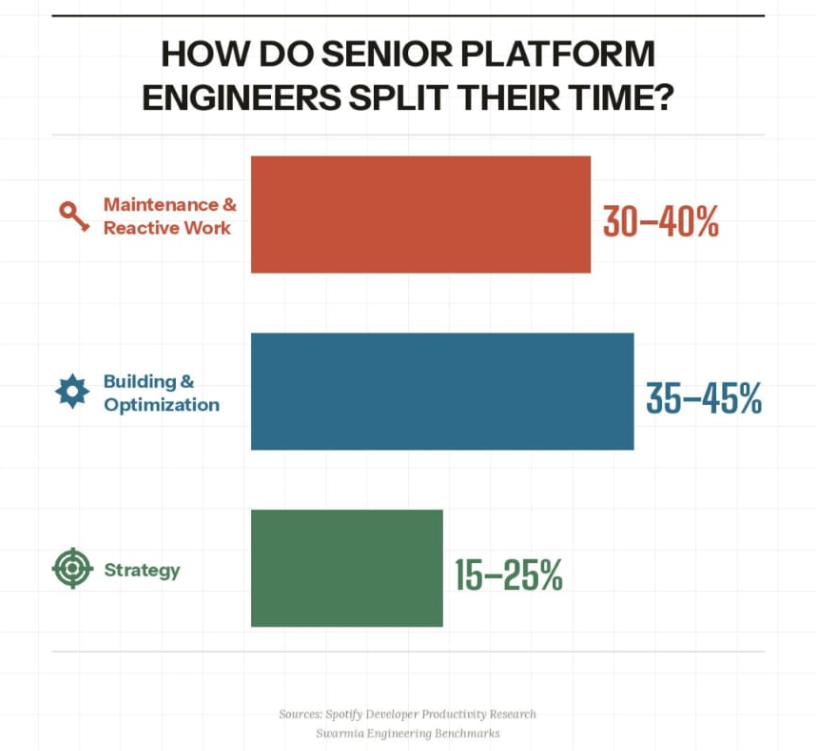
For senior platform engineers – the people you expect to shape your internal platform, your developer experience and your long‑term architecture – this is a quiet disaster. You're paying for leverage and getting firefighting.
The hidden tax on senior platform talent
Maintenance and reactive work will never be zero. Incidents happen. Legacy systems misbehave. Someone has to deal with brittle pipelines and noisy alerts. But when a third or more of your senior platform engineers' time disappears into this bucket, you've effectively turned them into "human circuit breakers" instead of strategic multipliers.
You see the symptoms everywhere:
- Every serious incident gets routed to the same two or three "platform heroes".
- These people spend their mornings triaging tickets and their afternoons unblocking teams.
- Weeks go by without any meaningful movement on the platform roadmap, because "production is on fire again".
OptimusHub is built precisely to attack this tax: by consolidating pipelines, standardizing environments and giving you a single control plane for delivery, it systematically reduces the amount of bespoke, fragile glue that generates reactive work in the first place.
When "building & optimization" is still mostly reactive
At first glance, 35–45% on building and optimization looks healthy. That's where new capabilities are delivered and reliability improves. In practice, much of this work is still reactive:
- Rebuilding pipelines because the previous generation is too fragile.
- Layering yet another home‑grown abstraction to paper over inconsistent environments.
- Incrementally tuning cost and performance instead of rethinking the model.
With OptimusHub, the centre of gravity shifts. Because pipelines, environments, policies and observability are defined once and reused across cloud and on‑prem, "building" starts meaning evolving the platform itself, not endlessly recreating slightly different versions of the same thing for every product team or every cluster.
Strategy: the smallest bar with the highest ROI
The smallest bar in the chart – 15–25% on strategy – is the one doing the most damage.
That's the time that should be invested in:
- Designing the next iteration of your internal platform and developer experience.
- Making explicit decisions about what the platform owns vs. what product teams own.
- Deciding where to standardize and where to allow variation.
- Choosing which parts of the toolchain to replace with a unified platform like OptimusHub versus maintaining yet another integration.
OptimusHub's goal is to create this strategic time by eliminating as much low‑value toil as possible. When your platform functionality, deployment flows and governance are centralized in one opinionated system instead of being scattered across a zoo of tools and scripts, your most senior engineers finally get the bandwidth to think two or three years ahead instead of two or three days.
Why the time split is structural, not personal
It's easy to blame this on "bad prioritization" or "not enough focus". In reality, most of the time waste is structural:
- Tool sprawl – each team has its own CI, its own release rituals, its own IaC flavor. Every exception leaks back into the platform team.
- Environment fragmentation – multiple clouds, multiple on‑prem clusters, different policies and access models per environment.
- No single pane for delivery – nobody has an end‑to‑end view of what's deployed where, which changes caused which incidents, and where the real bottlenecks are.
- Hero culture – organizations reward the person who saves the night, not the person who quietly removes an entire class of incidents.
OptimusHub is explicitly designed to change these structures. It gives you one delivery backbone that covers on‑prem, private cloud and public cloud, a unified policy and governance layer so security and compliance aren't re‑implemented in every tool, and built‑in observability of the delivery process so you can see where time is actually burned and prioritize platform work based on data, not anecdotes.
What a healthier time distribution looks like
You don't need 80% of a senior platform engineer's week to be "strategy". But you do need the graph to tilt in the other direction. A more realistic target once a platform like OptimusHub is in place:
The exact numbers will differ per company, but the direction is clear: every hour you systematically move from reactive toil into deliberate platform design compounds across the organization. Fewer incidents, faster delivery, simpler onboarding, more predictable releases.
OptimusHub exists to make that reallocation possible in the real world – not by asking senior engineers to "be more strategic", but by giving them a platform that removes as much waste as possible from the system they operate.
See it in action
OptimusHub runs entirely on your infrastructure - no cloud dependency, no data leaving your environment. Talk to us and we'll walk you through how it reduces toil and frees up your platform team.
Talk to us about your operating environment